Yellowstone 2025 May 4-5

On our second full day in Yellowstone we drove south from Mammoth to the Upper, Middle, and Lower Geyser Basins and to Norris Geyser Basin. It was rather different from scouring the landscape for wildlife since we knew what we were looking for and where it would be found. Geothermal features change over time, but they don’t move around as quickly as wildlife! Here are some of our photos:

Grand Prismatic Spring from the boardwalk. This view includes a large area of red thermophilic bacteria that provide a lot of the color around the spring. To the right of the red band you can see what appears to be a series of shallow terraces. Our guess is that these are caused by mineral deposits as the hot, mineral-laden water from the spring gradually cools. In the background you can see the blue-green of the deep center of the spring, with an edge of yellow where the water is the right temperature to support that color of bacteria.
Another view of Grand Prismatic Spring with a reflection of the sky in the shallow pools around the spring. Again, the color banding around the deep blue-green central pool comes from different kinds of thermophilic bacteria that grow in the water as it cools. No bacteria grow where the water is hottest, allowing the blue-green color to appear. Yellow for the next-hottest temperatures, then red for the next-hottest, then brown, and so on.
Final view of the shallow terraces and colors around Ground Prismatic Spring, with a reflection of the sky on the calm, slowly flowing water.
Osprey perched in tree next to the Firehole River. The bird kept watching us as we moved along the opposite side of the river, and it seemed like he was particularly interested in anyone who stopped walking to look at him for any length of time. When I raised my camera he moved to another tree. Maybe he was afraid that I would shoot him with a Canon.
Tourists in front of Norris Geyser Basin. This extremely dynamic geyser basin is the hottest in the park, and it has been a little different every time we visited over the years. Old steam vents stop and new ones start; small and large geysers make their appearance, and the colors caused by thermophilic bacteria and minerals are continually changing. A fascinating place!
Porcelain Spring portion of the Norris Geyser Basin. Lots of steam vents, hot water, and boiling springs in this view. The milky water seems to be caused by mineralization, while the oranges and yellows are thermophilic bacteria.
Waterfall on the Firehole River. We found this on a narrow one-way drive up Firehole Canyon; the drive had opened for the season just the day before.
Our previous photos came from May 2-4 when the weather was wonderful, but on May 5 Yellowstone had mixed snow and rain. A gentle reprise of winter. The weather varied according to elevation, with higher areas receiving more snow. This is Mammoth Hot Spring viewed from the General Store, but there is not much to see. Visibility was poor, and it was not a good day for photography. We did take a drive to look for wildlife, but the rain and snow hid the views.

Next post: back to good weather and good wildlife sightings.

Yellowstone 2025 May 3

Our previous post covered our arrival in Yellowstone and an evening wildlife-watching drive from Mammoth to Roosevelt on May 2. Today’s post shares a few photos from May 3, our first full day in the park. We did not want to go out super early, but decided instead to take a leisurely drive from Mammoth to Roosevelt and through the Lamar Valley all the way to the northeast entrance of the park. Beartooth Highway was still snowed in, so we drove to Cooke City, MT and then turned around to retrace our route back to Mammoth. Here is a sampler of what we saw:

Sandhill crane foraging for food in a swampy area near the road. The birds were easy enough to spot, and the camera auto-focus made it even easier by trying to identify and zero-in on the animal’s eye.
Pronghorn grazing in Lamar Valley. Hate to admit it, but we kind of took pronghorn (and bison) for granted since there were so many of them, so this photo probably deserved more care (and better focus) than we gave it. On the other hand, some of these shots were taken over such long distances that we could see heat waves in the air through the telephoto lens, even though it was a cool spring day.
Ground squirrel, part of the food chain for raptors, coyotes, etc. Cute, and kind of a nuisance, but part of the circle of life..
Red fox scavenging across the snow near the northeast entrance to the park. He took his time ambling across this meadow, stopping once or twice to sniff the air or poke his nose down through the snow, but we never did see him come up with anything to eat. No ground squirrels here?
Mountain goats between patches of snow. This was a long-range shot, so we couldn’t crop the image much tighter without giving up its clarity. Regarless, how many goats do you see in the photo? I count at least six.
Grizzly sow and cub grazing in a meadow. We spotted these bears in the distance on our return trip from Cooke City through Lamar Valley. Again, distance is not our friend when it comes to a clear photo, but there was no way to get any closer to the bears. Not that we want to get too close to bears…
Healthy-looking coyote prowling the territory. Seems like all the animals are on a mission to find food at this time of year. No surprise.
Bison jam, as a small herd uses the highway bridge to cross the Yellowstone River near Roosevelt.

We saw over 20 bears, scads of elk, many scads of bison, and several other kinds of wildlife over our five days at Yellowstone. How did we find all this wildlife? First, some of it is hard to miss. When bison walk on the road in front of you, it is hard not to take notice. Second, we found some of it on our own, since we know something about the animals and their habitat and kind of know where to look. Spring and fall are both good for wildlife spotting in Yellowstone because there are fewer people around to spook the animals. And third, when we see people looking through their spotting scopes, binoculars, or telephoto lenses, we stop and ask what they see. They are almost always pleased to share their finds, sharing the joy of the experience and saving the rest of us a bit of work. That spontaneous collaboration is a wonderful thing.

Yellowstone 2025 May 2

We love America’s national parks, but Yellowstone is probably our favorite. Our first visit was a year after we married in 1975. For that trip we camped at Pebble Creek in a little pup tent and were able to spend only one day in the park. This year we were blessed to visit Yellowstone for the 8th time, and it was our first visit in early spring. We arrived on May 2, before some of the park roads were open. Nevertheless, the weather, scenery, and wildlife watching were excellent! Rather than roughing it in a tent, we stayed in a cabin at Mammoth Hot Springs. After checking in and unloading the car, we took the road from Mammoth towards Roosevelt to see what we could before sundown. Here are a few of our photos:

Shortly after leaving Mammoth we found our first wildlife: a small herd of bison crossing the road. The herd included maybe a couple dozen adults and a few recently-born “red dog” calves. This would be the first of hundreds (or maybe thousands?) of bison we would see during our almost week long visit to the park.
Shortly after making our way past the bison, we spotted our first two bears of the trip. This mother grizzly and her cub were grazing on a hillside above the road. The sow was intent on foraging, but the cub looked up several times to check out the bear jam developing on the road below. I think the cub has a case of underbite, since the lower teeth kind of stuck out in almost every photo I shot.
The mother grizzly looks rather well off for having come out of hibernation only a few weeks earlier. Not exactly a glossy coat, but not shaggy, either. For that matter, the cub was larger than we expected, but apparently they grow really quickly at this point in their life.
After viewing the two grizzly bears we drove on towards Roosevelt. We found this herd of female elk was grazing a bit off the road, with a few bison further on in the distance. This photo also shows one of the challenges of photographing this big, sprawling scenery. God designed our eyes, mind, and imagination to take it in, up to a point, but it is hard to do it justice with a photograph.
We were heading back to Mammoth towards sunset when we found our third bear of the evening. This black bear crossed the road in front of our car, casting a bit of a shadow in our headlights. It was a little tricky shooting through the windshield, but the lighting and focus worked out reasonably well. We kept our distance, and the bear took his time getting to the other side.

More photos to come!

Homeschooling Meets Reality

Many of my grandchildren are being homeschooled at this time. I say “at this time” because the mix changes from year to year as babies grow up and become old enough for structured teaching via textbooks, worksheets, lesson plans, etc. and because a child who is homeschooled this year might have been in a preschool last year. Education is a dynamic, hands-on process, and parents who are on their game will adapt their children’s education for the good of the child and using the available resources, yet without sacrificing the continuity of the education.

A few weeks ago a friend commented something like, “Homeschooling is all well and good, but sooner or later those kids will need to come out and face reality.” I have heard this kind of thing before, but never from anyone who actively home-schooled their children. I wonder, though, what reality they have in mind.

Is it the reality of the teacher who told me that my daughters did not really need to study math or science, since girls were unlikely to need that knowledge?

Is it the reality of the high school teacher who did not know anything about trigonometry, but was teaching my daughter’s trig class anyway? Is it the reality of the teachers union protecting that teacher from reassignment without regard for the education of our children?

Is it the reality of certain parts of the public school campus being perpetually contaminated by marijuana smoke? The reality of bullies given protected status to bully others?

Don’t get me wrong. I am a product of public school education all the way from elementary school through post graduate work, and the educational system served me well. And my children were blessed with a large number of simply superb teachers in the Lutheran school and public schools they attended, notwithstanding the occasional issues mentioned above.

But other than the occasional incompetent teacher, self-serving teachers union, or pockets of bullying culture, what reality do they need to encounter that they are not already facing? From what I have seen, my grandkids receive an education tailored to their needs, learn at a pace that challenges rather than overwhelms or bores them, and maintain their curiosity, creativity, and interest for critical thinking all the while. But what about their supposed insulation from reality?

Their reality includes group excursions, field trips, and specialty classes with a couple dozen other home-schooled kids, exposing them to a range of personalities and levels of capability.

Their reality includes soccer teams, swimming lessons, horsemanship, and other kinds of enrichment, and some of these activities lead into league competition requiring teamwork, interpersonal skills, and leadership development.

Their reality includes community service, both formally (e.g., in local park districts) and informally (e.g., serving a shut-in neighbor or at church).

Their reality includes grocery shopping, visits to repair shops, trips to the library, trips to the parks, sight-seeing, and travel by car and by air, all of which are permeated with interactions with real people in real communities. Do they live a sheltered experience? No way!

A few weeks ago a friend commented something like, “Homeschooling is all well and good, but sooner or later those kids will need to come out and face reality.” I have heard this kind of thing before, and have heard it said of Christian schools, private schools, and the advanced placement programs and special needs programs in public schools. So what is the common denominator, other than maybe thinking that the grass is greener somewhere else? I am not sure, but rather than dwelling on the grumbling, let’s focus on the children.

Over the years a lot of my friends and co-workers have complained about their children, and our society as a whole often seems to see them as either a burden to be carried or as property to be managed. It is more important, and certainly more comforting, to see them as gifts that God gives to parents; gifts that God expects us to steward, protect, and nurture. We all fall short in this; none of us are perfect parents. Regardless, by the grace of God we do the best we can. I remember my parents teaching me about God, helping me learn the Lord’s prayer, and giving me the best education they could with the best available resources (time, treasure, and opportunities). We tried to do the same with our children, and now they are more than paying it forward with how they are raising our grandchildren. And homeschooling meeting reality is a big part of this.
The Edge of Credibility

A few days ago I was perusing Facebook and noticed a photo of two bears on a road through a beautiful forest. It was a nice photo, and, judging by the reactions, a lot of people appreciated it. A couple days went by, and I noticed what looked like the same photo, but there were four, five, or even a half dozen bears standing or lounging on the road. I was suspicious because bears can be a bit turfy, and it is unusual to see very many bears willingly stay that close to each other. Time went by, and a new photo turned up on Facebook. It was the same view, but this time there were at least 20 bears on the road! That confirmed my suspicion of a faked photo, but the artist was not done. A day or two went by, and the photo below turned up on Facebook:

AI-generated image of bears on a forest highway. Credit and copyright go to the creator of the photo.

So if you saw a series of photos like I described, at what point would you realize that the photos are fake? At what point would they lose their credibility? And how would you know?

In the case of bears, we know that cubs stay with their mothers until old enough to strike out on their own, but otherwise it is unusual to see very many bears together in one place. I have seen as many as seven grizzly bears at a time eating in a farmer’s field, but they all kept their distance from each other. And you have probably seen photos of bears fishing for salmon in Alaska, but they fight for the best fishing spots, and they are certainly not relaxed and lounging next to each other. So our understanding of bear behavior tells us when a photo of bears starts to reach the edge of credibility and when is is clearly a fake.

We need to bring the same sense of reality and experiential understanding into play when we read or hear the news. Sadly, much of the journalism in the US has been moving past the edge of credibility for years. As an editorial by Gerard Baker in the March 3 Wall Street Journal describes it, most of the media has become like a cult religion, saying whatever their customer base wants to believe, and without much regard for objective truth (my paraphrase). I detect this when I see the media asserting things that I can see with my own eyes, or know from personal experience, are not true. You have eyes and experience, so you can detect it, too.

One of our presidents once said, “trust but verify.” Good advice. We really need an honest, objective press, but in these times we need to verify what we read and hear now more than ever. Time to sharpen up our critical thinking skills, ask good questions, check multiple sources, and measure what we hear against what we know. And don’t fall into the trap of thinking, “who can know?” It may take time, but, as they say, the truth will out. Otherwise, if we give up on the truth, we may foolishly believe things as incredible as a hundred bears lounging on a highway.

Take a Long View

A few days ago one of my Facebook friends posted, “Falling like a rock! Have you looked at your retirement funds lately?” So I looked at our retirement funds, and saw that they are doing quite well. In fact, they grew by better than 7% in the three months since Trump was elected last November. In fairness, they were doing well before Trump was elected, too.

A day or even a week of “falling like a rock” can mislead us, and maybe three months of good performance can mislead us, too. It takes a long view to really understand the performance of retirement funds. We lost about 50% of our retirement funds in 2008 when the dot-com bubble burst, but we took a long view, and the funds grew back within two or three years. We lost about 30-40% again in 2022 when government shut down the economy because of Covid, but they grew back again, and then some. Our retirement funds have done quite well over the long haul, averaging 10-12% growth per year despite pandemics, presidents, and the occasionally chaotic market ups and downs. Taking a long view is the prudent approach.

Taking a long view is also prudent when we consider how the meeting between Zelensky and Trump blew up yesterday (February 28). You probably saw selected snippets of it on broadcast news or in social media. If you have time and interest, it would be worth your while to find and watch the entire meeting, which started out well enough but then devolved into an argument in its last few minutes. Why were we shown “selected snippets?” Because the anti-Trump people and the pro-Trump people immediately went into knee-jerk reaction mode about how the meeting was a disaster for Trump or a disaster for Zelensky, complete with cherry-picked video snippets to prove their points. The real questions, of course, are not who started or won the argument, but what is the strategic meaning and future of Ukraine’s war of self-defense against Putin’s Russia, and what should the US do with the situation? If we want the truth, we need to seek it out, but we will not find answers overnight. Alexa, Siri, and talking heads on screens notwithstanding, we need to take a long view to discern how we got here and where we may be going.

The argument yesterday brought some uncomfortable questions into the open. For example, words were exchanged over whether the US or Europe has given more money to Ukraine for supporting their war effort. But how are we supposed to know who has paid what without any audits or accounting, and how do we know how much money went for useful purposes and how much simply disappeared? The press makes much of the idea that Zelensky is the elected president of Ukraine just as Trump is the elected president of the US, suggesting that it was an argument between equals. But what does it mean to call Zelensky an elected president when he canceled elections? Zelensky and his allies claim to be defenders of democracy, and assert that Ukraine is the front line defending democracy, but what has he done to protect freedom of speech, religious freedom, or freedom of the press in Ukraine? Maybe Zelensky is better than Putin on some of these points, but the US press has shed so much dark on the situation that it is often hard to tell.

We need to see the war between Ukraine and Russia as part of a multidimensional contest of geopolitics. The human impacts are awful when you consider the people maimed, kidnapped, or killed, and the carnage continues. Think then on a wider level of economic, agricultural, and infrastructure disruptions, and their consequent humanitarian effects. Then on an even wider level we have Putin’s speeches about how the dissolution of the USSR was the greatest disaster ever to befall Russia, and his apparent desire to rebuild the empire. And we have the mixed history of US involvement with Ukraine over several presidential administrations. All of this leads to near-term and long-term questions for the US, Europe, and NATO.

Only time will tell if my friend’s concern about retirement funds falling like a rock was just an isolated data point or an emerging trend, and only time will tell if the Zelensky-Trump argument yesterday holds real strategic significance. The loud hue and cry from the press will not give us answers, at least in part because it has such a strong flavor of immediate political gratification rather than fact-finding and insight. Instead, we need to take a long view to understand the times. We can take comfort, though, that our welfare and our times are in God’s hands, even if we do not have the whole picture.

Gravity with a Swirl

I am no expert on Einstein’s general theory of relativity, but seem to recall that it predicts that gravity, mass, space, and time are all inter-related. Furthermore, according to the theory, gravity is not constant, but varies. And I am here to tell you, with tongue firmly in cheek, that we have experimental evidence of variable gravity here in our own home!

First, gravity apparently varies from place to place in our home. Books don’t fall very often in our library, stuff stays put on the dresser in our bedroom, and we rarely see anything tumble to the floor in the living room, but gravity seems to be a little stronger in the kitchen. How do we know? Because that is where food, dishes, and any number of other things spill, drop, or fall. Every day. If we had a dog, he would be on constant cleanup duty in the kitchen. And the kitchen is where things not only fall, but break, if they are in any way breakable. Granite counters are not very forgiving when a dish hits it, and the extra gravity we seem to experience in the kitchen has cost us one juice glass after another.

Not only does it appear to vary in strength from one part of our home to another, gravity also seems to include some localized turbulence. We have good observational evidence that gravity in our garage has waves and swirls. How do we know? A green recycling box sits on the garage floor right outside the door. When we have a can, bottle, cardboard, or some other item to recycle, we simply open the door, lean out into the garage, and drop the item into the box. Easy, except that the apparent gravitational swirl makes the item almost always miss the box. It doesn’t matter how far we reach towards the box or how carefully we aim; the can or bottle almost always diverts away from the box and lands on the garage floor. I would think that an invisible elf batted it off course, but the only invisible elf I know of lives in my cell phone to meddle with the voice recognition and spell check software. I don’t think batting incoming cans away from the box is part of their contract, so it must be a swirl in the gravity.

So there you have two sets of observations to support the idea of variable gravity, or gravity with a swirl. What about you? Have you seen any such phenomena at your home?

Contest Theme: Challenge

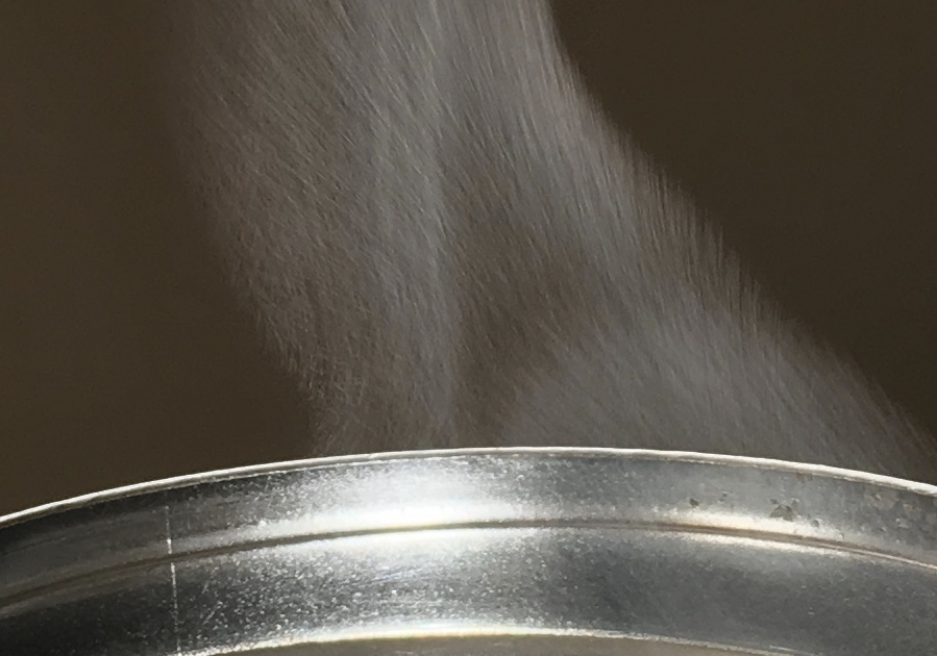
Last week’s Christian Photographers on Facebook contest theme was more of a challenge than usual. We were asked to submit an image that we setup beforehand using our knowledge of photography and of our equipment. After some thought, I submitted this image:

Wisps of steam rising above coffee in a stainless steel cup.

You might recognize this photo as similar to the image that heads up this “Cup of Brouhaha” blog. Indeed, it is one of several consecutive photos I shot with a cup of hot coffee on that cool morning. But what makes the steam plume wispy? Actually, the white visible portion of what we call steam is microscopic water vapor droplets. I do not have enough expertise in thermodynamics or fluid dynamics to explain the white streaks, or wisps, of water vapor. However, I would speculate that something about the electrostatic properties of the droplets makes them link up into chains, but also provides a slight repelling force between chains so that they remain separate in a laminar (rather than turbulent) convection-driven flow process. Can any of you correct me or shed light on this “wispy steam” phenomena?

By the way, I posted several more photos to my gallery at https://jesseyow.com/electrons-are-cheap/ — enjoy!

Contest Theme: Birds

The theme of last week’s “Christian Photographers on Facebook” photo contest was Birds. As usual, I learn from the other entries as I try to grow past serendipity in the creative side of the art. Here are the photos I submitted for the Birds contest theme, plus some others:

Mallard duck in flight. I have great respect for anyone who can photograph active children, butterflies, or birds in flight. All of them are moving targets (the butterflies move when you least expect it, and fly erratic paths), so it takes a bit of skill and a bit more luck to take the shot. Getting it in focus is a bonus!
Anna’s hummingbird perched in our orange tree. These hummingbirds are in our area year-round, and tend to be a little turfy. They are not happy with other hummingbirds that might come through on migration, and they each usually try to stake exclusive claim to our hummingbird feeder.
Anna’s hummingbird in flight, hovering near the feeder. The throat is red when sunlight hits it at just the right angle, but few of my photos look as spectacular as the ruby-throated hummingbirds seen in other areas.
Rufous hummingbird. About the same size as the Anna’s hummingbirds, these have begun showing up for a week or two each spring as they journey north on their annual migration. We never see them in the fall, so maybe their trip south takes a different route. The Anna’s hummingbirds resent their presence and try to drive them away from the feeder, but with limited success.
Rufous hummingbird perched in our orange tree. He kept careful watch so as to not be surprised by his rivals.
Hawk on a fence, watching for hikers with cameras. Or, more likely, maybe he was watching for ground squirrels. Not sure if this is a red tailed hawk, a Cooper’s hawk, or some other variety.
Red tailed hawk soaring near the Livermore Valley. Not an uncommon sight, but we usually see more turkey vultures than hawks or eagles. The windmills on adjacent ridge lines harvest a number of hawks, eagles, owls, and other birds year-round, but I never hear of turkey vultures killed by the blades. Maybe that’s because the vultures are more likely to stay out over the valleys?
Found this bird on Hawaii (the Big Island) a little over 10 years ago. If I ever knew what it was, I have forgotten. Please send me a note or comment if you know.

If you appreciate these shots, don’t forget to visit my photo gallery at https://jesseyow.com/electrons-are-cheap/ from time to time. I add photos to it every week or two, typically a half dozen or so at a time, and most of them are higher resolution than these. Enjoy!!

Contest Theme: Silhouettes

The theme of this week’s “Christian Photographers on Facebook” photo contest is Silhouettes. I usually enter one or two photos in each week’s contest, but this week I entered three of my favorites. After learning once again to spell silhouette, the real value (for me) lies in the other entries. I understand much of the technical side of photography, but have more to learn when it comes to picture composition and the creative side of the art.

Here are the photos I submitted for the Silhouettes contest theme. You can find these and many more in my photo gallery at https://jesseyow.com/electrons-are-cheap/

Massive sequoia trees in late afternoon sun. You can almost hear the quiet in this Yosemite National Park grove, although “almost hear the quiet” seems like something Yogi Berra might have said. Yogi was a catcher for the New York Yankees; look on line for a sampler of his sayings and you will see what I mean. At any rate, the crisp silhouettes of the trees agains the deep blue sky makes this one of my favorites.
Suspension bridge across the Dardanelles silhouetted in the setting sun. This bridge crosses between Europe and Asia, and has the longest center span (over 6600 ft) of any bridge in the world. There were construction cranes on top of each of the two towers when I shot this photo, but I don’t know if they were there to put finishing touches to the bridge, which has been open to traffic for a few years, or if they are a permanent fixture to support tower maintenance.
Tall grass in the wind. I noticed this photo op on a winter day in Texas. We had just arrived at church for a friend’s wedding rehearsal, and the setting sun highlighted these tufts of grass standing bravely against the cold wind. You might think this was somewhere on the prairie, but it was actually on an island in the church parking lot!